2026 guide

NEC4 Contract Management Software: A 2026 Guide

A practitioner's guide to the contract management systems UK teams use on NEC4 work. What the four core procedures ask of you, what each provider says its system does, and the one thing every system on the market has in common.

NEC4 contract management software helps project teams comply with the formal NEC4 procedures: early warnings, compensation events, notices, quotations, payment and the programme. It gives both parties a single, shared, auditable communication and management system, which is a long way ahead of running a contract on email and spreadsheets.

This guide is not a ranking. We have not used all of these systems, and neither has anyone else who writes about them honestly. What follows is a practitioner's view of the four procedures that consume most of the effort on an NEC4 job, what each provider states its system does, in its own words and with a link to the source, and one observation that applies to every system in the category, ours included.

Gather wrote this guide. We make a record management system that sits underneath contract management software rather than competing with it, so we have kept our opinions to the part of the market we actually work in and left each provider to describe its own.

02

The Four Procedures, and Where They Bite

Strip away the branding and every system in this category is built to administer the same four things. They matter to the Project Manager and the Contractor equally, and each has a close equivalent under JCT and FIDIC, so the thinking travels even if you are not on an NEC form.

01Early warnings

NEC4 ECC clause 15. FIDIC 2017 sub-clause 8.4, Advance Warning. JCT has no direct equivalent, the nearest being the duty to notify delay.

The early warning is the cheapest clause in the contract and the most under-used. It costs nothing to raise, it obliges both parties to meet and consider how to avoid or reduce the effect, and it creates a dated record that the matter was known about. Its whole value is timing. An early warning raised in week one is a risk you can still design out. The same matter raised in week nine is a claim.

What a contract management system adds is discipline and shared sight. The register lives in one place, both parties see the same entries, the risk reduction meeting has an agenda that writes itself, and nothing depends on whether a particular person remembered to copy in the right people. What it cannot do is decide that something on site is worth warning about. That judgement is still made by a human, on a particular day, in a particular set of conditions.

02Compensation events

NEC4 ECC clauses 60 to 65. JCT Relevant Events and Relevant Matters, plus Variations. FIDIC 2017 clause 20 Claims and clause 13 Variations.

Compensation events are where the commercial position of a project is actually decided, and where the procedure is least forgiving. There are notification duties, quotation periods, assessment periods, and a deemed-acceptance mechanism if a reply does not arrive in time. Under clause 61.3 a Contractor that does not notify within eight weeks of becoming aware of an event may lose entitlement to time and money altogether, and there are equivalent traps on the other side of the table if the Project Manager does not respond.

This is the procedure contract management software is best at. It turns a set of deadlines into a workflow, it makes the clock visible to both parties, and it keeps the paper trail in an order that will survive an audit or an adjudication. It is genuinely hard to run compensation events well at scale without a system of some kind.

The limit is the same as for early warnings, and it is worth being precise about it. The workflow begins at the moment someone decides an event has happened, or might have happened. Everything before that moment, the ground conditions in the diary, the standing time on a plant record, the instruction given verbally at a Thursday progress meeting, sits outside the system until a person carries it in.

03Payment

NEC4 ECC clauses 50 and 51. JCT interim payments under section 4. FIDIC clause 14. Payment and pay less notices under the Construction Act apply across all of them.

Payment is the procedure with the hardest statutory edges. Assessment dates, due dates, final dates for payment, payment notices and pay less notices are all time-bound, and in the UK the Housing Grants, Construction and Regeneration Act sits behind whichever form you are using. Miss a pay less notice and the notified sum becomes payable, whatever the underlying valuation says.

Systems help here by tying dates to a calendar rather than to a person, by holding the assessment and its backup in one record, and by giving both parties the same view of what has been notified and when. The friction that remains is upstream: assembling the substantiation, the Defined Cost records, the timesheets, the delivery tickets, the plant returns, so that an assessment can be made confidently and defended later.

04Programme

NEC4 ECC clauses 31 and 32, plus clause 62.2 for compensation event programmes. JCT master programme clause 2.9. FIDIC clause 8.3.

NEC treats the programme as a live management document rather than a filing requirement. It has to show the Accepted Programme, planned Completion, float, time risk allowances, and the order and timing of the work, and it has to be revised at the stated interval. A programme that is not accepted, or that has drifted from what is happening on site, weakens every other procedure that depends on it, compensation event assessment most of all.

Contract management systems handle the submission, acceptance and revision cycle: who submitted what, when, whether it was accepted, and on what grounds it was not. Keeping the programme itself honest is a separate discipline, and it depends on progress information arriving from site quickly enough to be worth planning around.

Read across those four and a pattern shows up. Each procedure is a decision, followed by a deadline, resting on a record. Contract management software is very good at the deadline. The decision and the record are where projects actually come unstuck.

03

The Providers, In Their Own Words

These are the systems UK contractors and client teams shortlist most often for NEC4 work. We have not scored them. Each entry sets out what the provider states about its own product, with a link to the source, plus the contract forms and users it names publicly. Where you see quotation marks, the words are the provider's, not ours.

ProviderContract forms statedProcedures named on their siteUsers named publiclyG-Cloud listed rate
Thinkproject CONTRACTS (CEMAR)NEC, FIDIC and other contract typesContract administration, collaboration, complianceNot listed on the product page£435 a licence a month
FastDraft (Built Intelligence)NEC3, NEC4, JCT, FIDIC, IChemE, bespokeEarly warnings, compensation events, communications, ERP payment dataEnvironment Agency, National Grid, Kier, AECOM, Balfour Beatty, Mace, Wates, Transport Scotland£250 a licence a month
Sypro Contract ManagerNEC, JCT and others, plus custom contractsCompensation events, early warnings, programme managementTransport for Wales, AtkinsRéalis, VINCI, Pick Everard, Willmott Dixon£25.00 to £65.00 a user a month
C-COMNEC, FIDICEarly warnings, compensation events, claims, variations, instructions, daily diary, risk registerMurray & Roberts, Worley, Astron Energy, Ivanhoe MinesNot listed on G-Cloud
Contract Bee (Digital Beehive)NEC3, NEC4Early warning and compensation event management, programme management with remindersYorkshire Water, Anglo American, Sasol£30 to £49.99 a user a month
Oracle Primavera Unifier, NEC4 configuration by RPC UKNEC4 ECC and PSC, on a platform also used for other formsNotifications, instructions, submissions, acceptances, certificate generationNot listed on the solution page£107.42 to £584.82 a user a month

A note on the pricing, because it is more useful than it looks

Most write-ups of this market say pricing is "on application". That is true of the vendor websites, but it is not the whole picture. Five of these six publish rates on the UK Government's G-Cloud framework via the Digital Marketplace, where a supplier has to file a service definition and a pricing document to be bought by a public body. Every figure in the table above is that filed rate, linked to its listing, correct as at August 2026.

Read it carefully, because the units are not the same and the numbers are not comparable as they stand. Sypro, Contract Bee and RPC's Unifier configuration file per user per month. Thinkproject and FastDraft file per licence per month, which on those listings is a different unit entirely. A £435 licence and a £30 user are not two points on one scale.

What the figures do give you is a floor, a ceiling and a negotiating anchor that did not exist before you walked into the room. They are list rates on a public framework, usually excluding VAT, and they are a starting position rather than a final one. Sypro, Contract Bee and FastDraft also offer a free trial through their listings. Contract Bee's is 30 days with full feature access. Thinkproject's listing states no free trial.

The practical move is the same as it always was, just better armed: ask every provider to restate its quote against the same project count and the same user count, and ask why it differs from what the company has filed on G-Cloud.

Thinkproject CONTRACTS (CEMAR)

Supports NEC, FIDIC and other contract types. Supporting the construction industry since 2000.

CEMAR, now sold as Thinkproject CONTRACTS, is the system most UK practitioners picture when they think of NEC contract administration at programme scale. It has a long track record on major infrastructure.

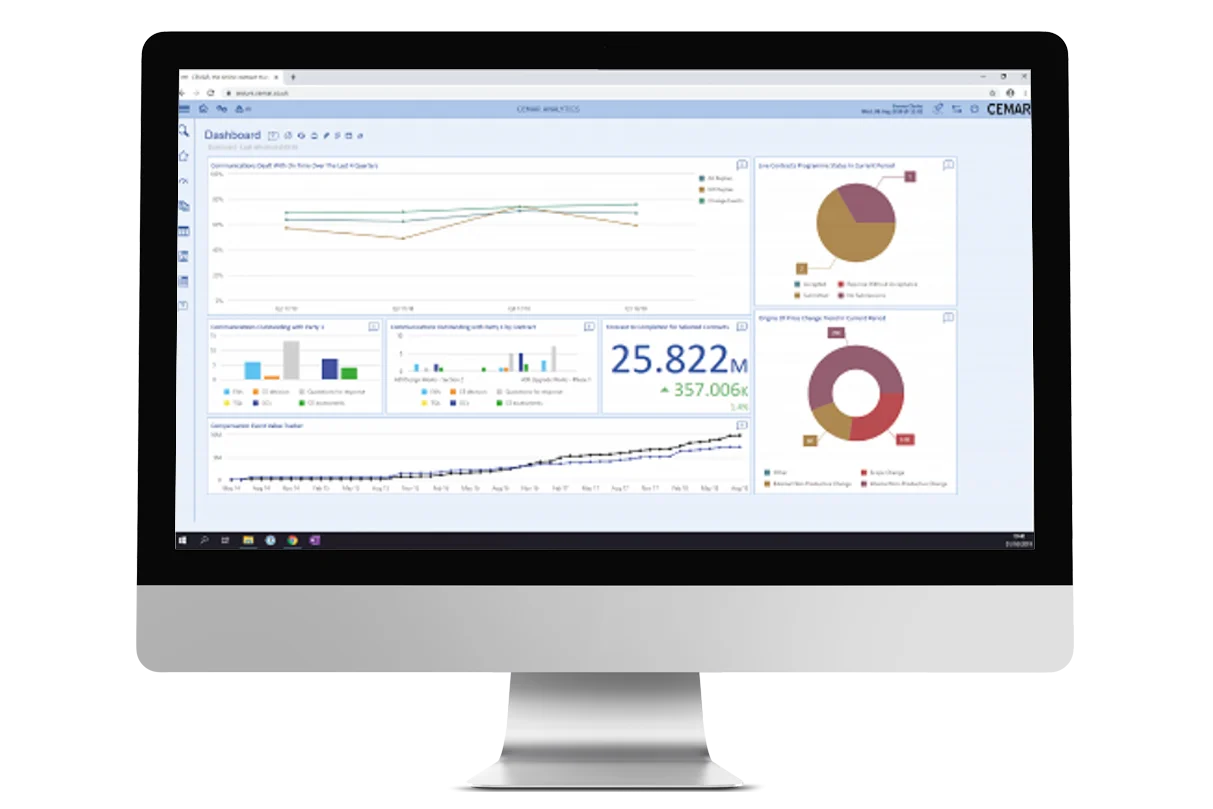
CEMAR Analytics dashboard in Thinkproject CONTRACTS

What Thinkproject says: the product "streamlines contract management for Project Managers, General Contractors and their supply chain", "improving collaboration and compliance, whilst reducing risk and simplifying complex contracts". It was "developed by industry experts" and sits inside Thinkproject's wider connected data ecosystem for managing built assets across their lifecycle. Its G-Cloud listing adds that the platform handles NEC3, NEC4 and FIDIC with real-time analytics through embedded Microsoft Power BI.

Our read: we agree with the governance framing. If you are running a programme where every notice and decision has to survive audit years later, this is the part of the market built for that.

FastDraft (Built Intelligence)

Supports NEC3, NEC4, JCT, FIDIC, IChemE and bespoke contracts.

FastDraft is the broadest contract coverage on this list, which is the point of it: one platform across several contract families rather than an NEC-only tool.

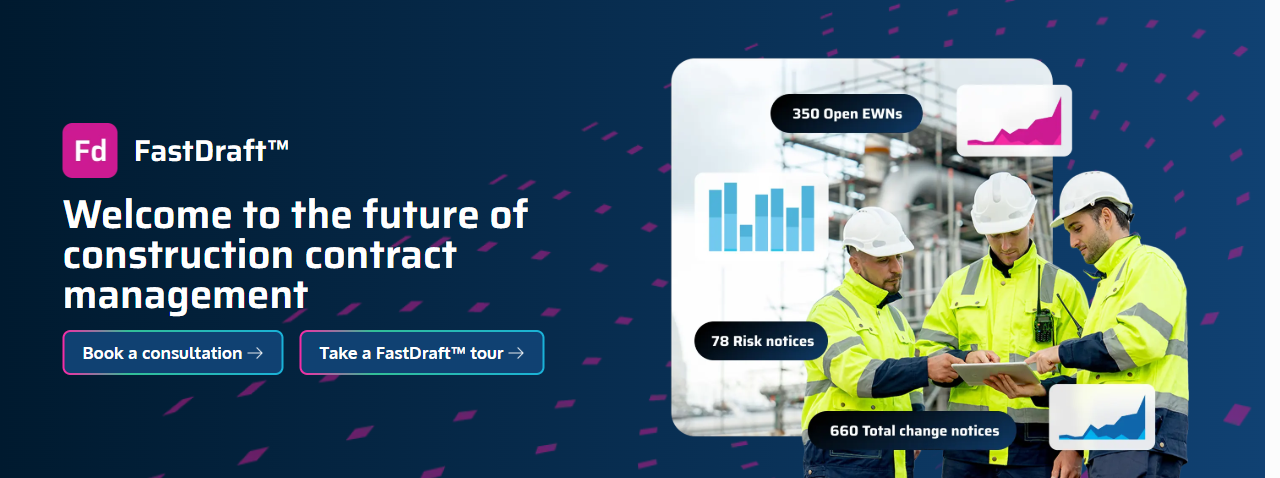
FastDraft construction contract management by Built Intelligence

What Built Intelligence says: FastDraft lets teams "manage early warnings, compensation events and project communications in one platform", with pre-built workflows and integration to CDEs, ERPs and BI tools. Its AI contract coaching "empowers managers to replicate success, turn data into coachable moments, and drive improvements". The company publishes customer research figures of 92% reporting weekly time savings, 93% improved visibility of notices and deadlines, and 95% stronger audit trails. Its G-Cloud listing adds payments and defects management to that scope.

Our read: the coaching idea is the interesting one. It accepts that the hard part of contract administration is human behaviour rather than form filling, which is a view we share.

Sypro Contract Manager

States it "compliantly manages all global contract types, whether you use NEC, JCT or others", with custom contract upload. Part of the Pagabo Group.

Sypro was created by Dr Stuart Kings, a member of the NEC4 drafting team, so the NEC pedigree behind it is real rather than retrofitted.

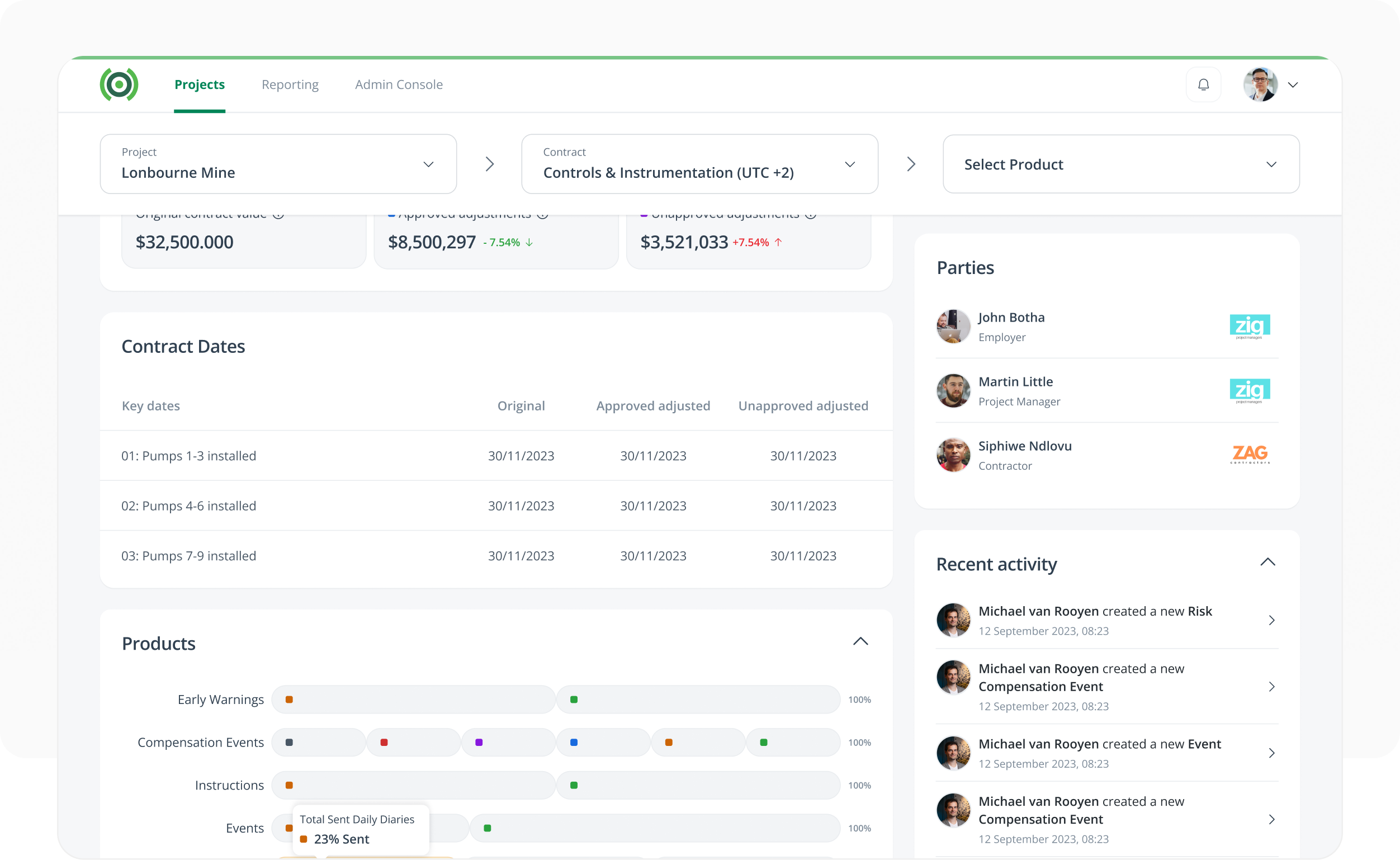
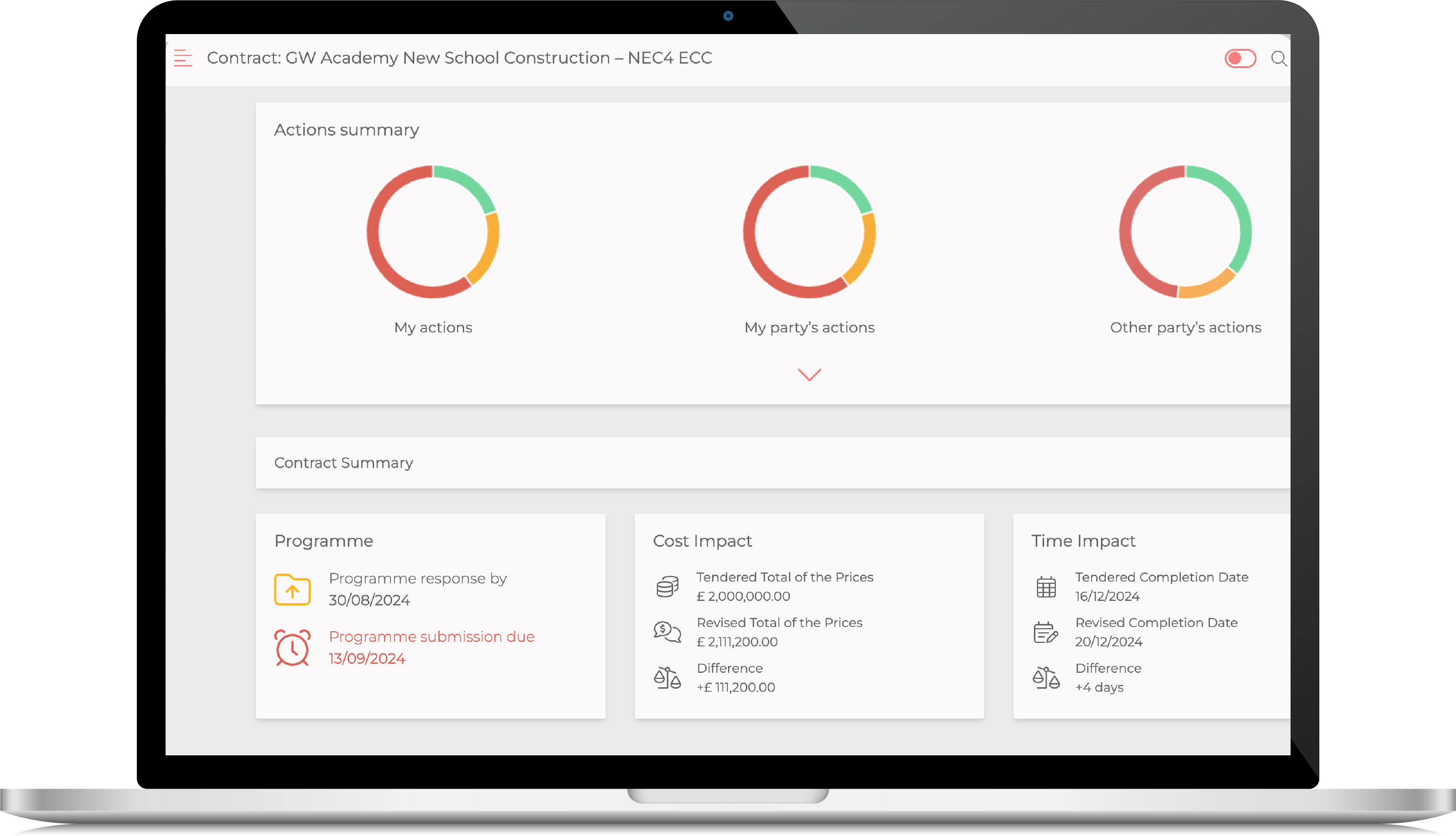
Sypro Contract Manager NEC4 ECC contract dashboard

What Sypro says: the system provides "integrated alerts for compensation events, early warnings, and programme management", real-time dashboards that "deliver actionable insights", and full project visibility, so "your project team will never miss an action" and there are "no more costly missed emails or calls". It names Transport for Wales, AtkinsRéalis, VINCI, Pick Everard and Willmott Dixon among its users, and its G-Cloud listing records ISO 27001, ISO 9001 and Cyber Essentials Plus accreditation.

Our read: "never miss an action" is the right ambition for the administration layer, and it is a fair description of what a good alerting system does once an item is in it.

C-COM

Supports NEC and FIDIC. Aimed at project owners, EPCM consultants and EPC contractors.

C-COM comes from the team behind the C-Link procurement platform, and covers early warnings, compensation events, claims, variations, instructions, a risk register and a daily diary. It is the one system here without a UK G-Cloud listing, and its published users sit in mining and energy rather than UK public works.

C-COM contract administration dashboard

What C-COM says: it "automates, standardizes & digitalizes contract administration" and delivers "real-time commercial intelligence", giving "immediate awareness of potential and actual delays", "better mitigation outcomes", "teams solving problems instead of doing admin" and "disagreements resolved without legal escalation". It names Murray & Roberts, Worley, Astron Energy and Ivanhoe Mines.

Our read: "teams solving problems instead of doing admin" is the best one-line statement of what this whole category is for, and it is the sentence we would put on the front of every one of these websites.

Contract Bee (Digital Beehive)

Supports NEC3 and NEC4. Built in Leeds.

Contract Bee is purpose-built for the NEC family rather than adapted from a general contract system, which shows in how closely the workflows follow the procedures.

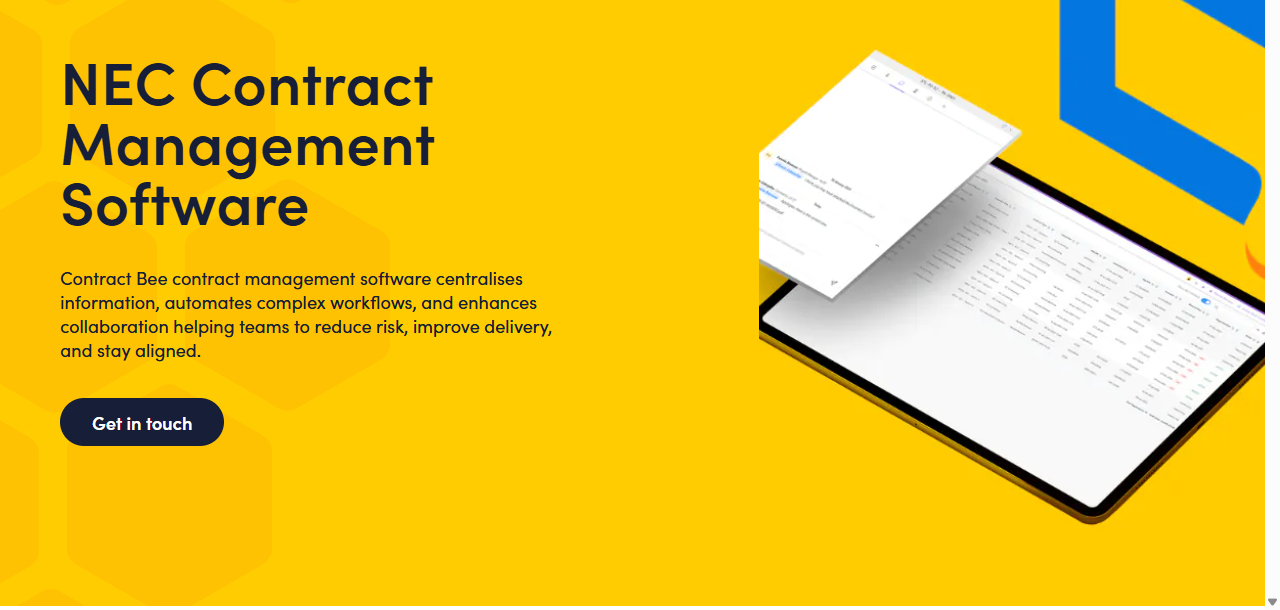
Contract Bee NEC contract management software by Digital Beehive

What Digital Beehive says: Contract Bee provides "automated early warning and compensation event management" and "programme management with built-in reminders", tracking deadlines and automating key events. It "centralises information, automates complex workflows, and enhances collaboration" so teams can "reduce risk, improve delivery, and stay aligned". Yorkshire Water, Anglo American and Sasol appear as published case studies, and its G-Cloud listing offers a 30-day free trial with full feature access.

Our read: deadline automation on the NEC procedures is exactly the right first job for a system, and doing it for the whole NEC family rather than ECC alone is genuinely useful for teams running subcontracts and service contracts alongside the main works.

Oracle Primavera Unifier, NEC4 configuration by RPC UK

NEC4 ECC and PSC, configured on Oracle Primavera Unifier. RPC UK was Oracle's Global Partner of the Year for Construction and Engineering Industry Solutions in 2025.

RPC UK built a preconfigured NEC4 accelerator on top of Unifier, so NEC administration sits in the same platform as cost management and scheduling for organisations already standardised on Oracle.

RPC UK Oracle Primavera Unifier NEC4 configuration

What RPC says: the solution lets teams "manage Notifications, Instructions, Submissions and Acceptances for ECC and PSC, with automated certificate generation for key contract milestones", with automated response time tracking, "built-in integration to Oracle Primavera Unifier's out-of-the-box cost management capabilities" and "integration of scheduling data in Primavera P6". Its G-Cloud listing describes the Accelerator configuration as 55 or more business processes and 350 or more reports and dashboards, with NEC4 available as an added module.

Our read: the P6 link is the distinctive part. Programme is one of the four procedures, and having contract administration and the schedule in one ecosystem removes a reconciliation step that most teams do by hand.

04

What Every System Here Has In Common

Read those six descriptions next to each other and one thing is true of all of them, and of every other system in the category. Each one begins at the moment a person decides something has happened. Someone judges that a matter is worth an early warning, that an event might be compensable, that a valuation needs an entry, that the programme no longer reflects the job. From that moment on, these systems are excellent: the deadline is tracked, the notice is served, the record is auditable, both parties see the same position.

Before that moment there is a gap, and it is the same gap for the Project Manager and the Contractor. The information that should trigger the decision is sitting in the daily record. The ground was different from the drawing. The gang stood for three hours. The instruction was given at the progress meeting and never written down. The delivery arrived short. None of that is in the contract management system yet, because nobody has carried it in.

That gap is measured in days, and days are what the NEC is really about.

Project Management is about influencing the future. Everything else is administration.

Dr Martin Barnes, originator of the NEC

If you want to influence the future you have to know the present, and you have to feed it into your contract management system quickly. Every day of lag between something happening on site and someone acting on it is a day of lost influence, because the options narrow as you go. On day one a matter can be designed out, resequenced or agreed in a conversation. On day forty the same matter is a claim, an argument, and a set of records that somebody has to reconstruct.

This is not a criticism of contract management software. It is a description of where the category boundary sits. Administration systems administer. The question every buyer should ask is what is feeding them.

05

Where Gather Fits

Gather

Pairs with every contract management system in this guide.

Gather is not an alternative to the systems above. It is the record management layer they all assume you already have: the site diary, the labour, plant and materials record, the delay notes, the narrative and the photographs, read by an AI QS agent that surfaces what the four procedures need before the dates start to bite.

The output goes into whichever contract management system you run. Gather does not administer your contract. It makes sure the system that does is looking at a complete picture, and looking at it in days rather than months.

What it covers: the commercial edge of the four procedures. Matters worth an early warning, potential compensation events, the substantiation behind an assessment or a payment application, progress against the programme, productivity, and the record quality that disallowed cost arguments turn on.

Why it helps both sides: a Project Manager assessing an event and a Contractor pricing one are arguing about the same absent records. Better records do not favour a party, they shorten the argument. Faster, better substantiated positions are worth more to a project than winning slowly.

Will built Gather after nearly losing £20 million on the North West Electrification Programme. The records existed. They were scattered across emails, spreadsheets, site vehicles, and a supervisor's notebook nobody could find, and by the time the team assembled the evidence the commercial position had gone. That is the gap Gather closes.
06

Also Worth a Look

If your search is broader than NEC4 administration alone, three more names come up often. NEC Digital is the official NEC drafting and management tooling. Xpedeon and Causeway both offer commercial management suites where contract handling is one module inside a wider construction finance platform. They are reasonable additions to a shortlist if you are buying a whole commercial system rather than a contract tool.

07

Questions to Ask Any Provider

Rather than tell you which system is best, here are the questions that separate them once you are in a demo. They work on any of the six, and on us.

  • Which forms, and which versions? NEC4 ECC is not the whole family. Ask about ECS, PSC, TSC and the short forms if you run subcontracts and service contracts alongside the main works.
  • Show me the clock. Ask to see the reply periods, the deemed acceptance mechanisms and what happens on the screen when one is about to expire. Both parties have deadlines under NEC4, not just the Contractor.
  • What gets an item into the system in the first place? Every system administers what is entered. Ask what triggers the entry, and how long it typically takes between something happening on site and it appearing.
  • What does the programme integration actually do? Ask whether it holds submissions and acceptances, or whether it also reads a P6 or Asta file, and what it does with progress.
  • Where does substantiation live? Ask how the assessment is linked to the records behind it, and what an auditor or adjudicator would see three years later.
  • What is the AI doing? Ask specifically whether it drafts text, prompts behaviour, or reads evidence and reaches a view. Those are three very different products.
  • How is it priced, per what? Per user, per licence, per project or per organisation. Check the provider's G-Cloud listing before the meeting, get every quote restated against the same two numbers, and ask why the quote differs from the filed rate.

The systems in this guide will answer the first six well. The third question is the one worth pressing on, whichever you choose, because it is the only one where the answer usually sits outside the software.

Frequently Asked Questions

What is NEC4 contract management software?

NEC4 contract management software helps project teams comply with the formal NEC4 procedures, such as early warnings, compensation events, notices, quotations, payment and the programme, inside a single shared auditable system rather than on email and spreadsheets. It keeps a complete record of every notice and decision so the contract position survives audit.

What is the best NEC4 contract management software?

There is no single best system, and any guide that claims otherwise is ranking products most of its authors have never used. The established options in the UK are Thinkproject CONTRACTS (CEMAR), FastDraft, Sypro, C-COM, Contract Bee and Oracle Primavera Unifier with RPC UK's NEC4 configuration. Choose on contract forms, scale and how the system fits your existing stack, then ask every provider the same set of questions. What they all have in common is that they administer events a person has already identified, which is why most teams pair them with a record management layer.

What are the four core NEC4 procedures?

Early warnings (clause 15), compensation events (clauses 60 to 65), payment (clauses 50 and 51) and the programme (clauses 31 and 32). Each has a close equivalent under other forms: FIDIC has advance warning at sub-clause 8.4, claims at clause 20 and programme at clause 8.3, while JCT uses Relevant Events and Relevant Matters, interim payments under section 4 and the master programme at clause 2.9.

Does contract management software detect compensation events automatically?

No. Contract management systems record, track and process compensation events after a person has identified one. Detection from evidence is a different job that needs the daily record: Gather uses an AI QS agent to read site diaries and surface potential compensation events for review, then feeds them to whichever administration system you run.

How much does NEC4 contract management software cost?

Vendor websites quote on application, but five of the six list published rates on the UK Government's G-Cloud framework: Sypro at £25.00 to £65.00 a user a month, Contract Bee at £30 to £49.99 a user a month, RPC's Oracle Primavera Unifier at £107.42 to £584.82 a user a month, FastDraft at £250 a licence a month and Thinkproject CONTRACTS (CEMAR) at £435 a licence a month, correct as at August 2026. C-COM is not listed on G-Cloud. Per user and per licence are different units, so the figures are a negotiating anchor rather than a like-for-like comparison. Ask each provider to restate its quote against the same project count and user count.

Is Gather a rival to CEMAR, FastDraft or Sypro?

No. Gather is a record management system: the site diary and daily commercial record that sits underneath contract management software. Those systems administer the events your team raises, and Gather makes sure the record behind those events is complete and current. Pair it with whichever administration system you choose rather than treating them as alternatives.

The layer underneath

Whichever system you run, it can only administer what it is given.

Book a 15-minute Gather demo and see what your daily records are already telling you.