
What you need to know
- If it is not dated that day, it is not proof. It is a recollection.
- Write the hours and the reason on the site diary that shift.
- Rosie reads those entries so a missing line is visible before you apply for the money.
The Documentation Disconnect
There's a persistent attitude in construction that treats site records as administrative overhead. Paperwork that gets in the way of real work. Something to be tolerated rather than valued.
This attitude costs contractors millions every year.
Without records, you have no proof. Without proof, you have no case. Without a case, you have no payment. That chain reaction turns legitimate work into unrecoverable loss.
The Three-Part Thesis
Understanding why documentation matters requires grasping three interconnected truths:
1. Without Records, You Lack Evidence
Memory fades. People leave projects. Verbal agreements get reinterpreted. When a dispute arises six months after an event, the only thing that matters is what's written down.
A site supervisor might remember exactly what the client said about that variation. But in a meeting room with lawyers present, memory doesn't compete with documented evidence.
2. Without Evidence, Disputes Become Unwinnable
Construction disputes aren't decided by who's right. They're decided by who can prove they're right. The contractor with comprehensive records wins against the contractor with better arguments but no documentation.
Adjudicators, arbitrators, and courts need evidence. They need dates, times, quantities, instructions, and acknowledgments. Stories without supporting documentation are just stories.
3. Without Winnable Disputes, Payments Disappear
When you can't prove your claim, you don't get paid. The variation you completed in good faith, the delay caused by the client, and the additional resources deployed on instruction all become unrecoverable.
Where Documentation Fails
The breakdown typically happens in predictable ways:
Verbal Agreements on Variations
The project manager says "go ahead with that change, we'll sort the paperwork later." The work gets done. The paperwork never appears. Six months later, the client has no recollection of authorising additional work.
Without a contemporaneous record of the instruction, you're left arguing about what was said. With no evidence, your team loses out on thousands of pounds in unpaid work.
Incomplete Daily Records
Daily diaries that capture weather and workforce numbers but miss the commercially significant events. The instruction received at 10am. The condition encountered at chainage 450. The delay caused by late information.
These gaps seem minor at the time. They become catastrophic when you need to substantiate a claim.
Disconnected Information
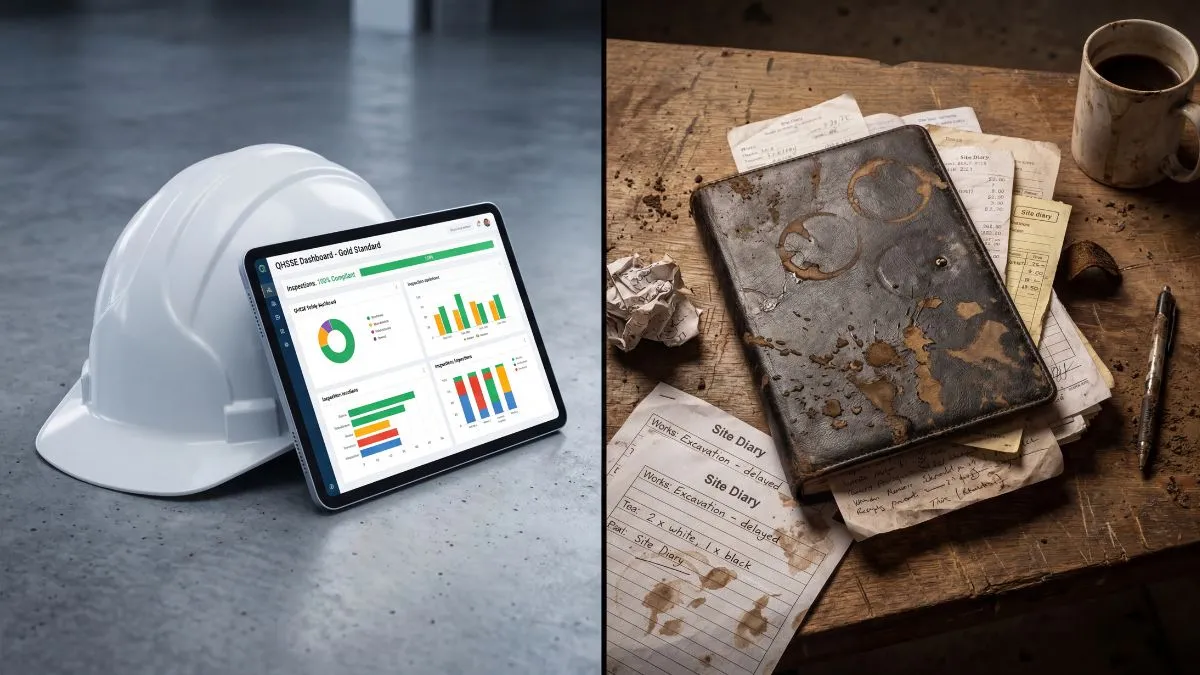
Records exist, but they're scattered. Photos on someone's phone. Notes in a supervisor's notebook. Emails buried in inboxes. When it comes to building a coherent picture, the pieces don't connect.
Records as Defence
Clear, consistent documentation is your first line of defence when conflicts arise. Whether it's delays, defects, or scope disagreements, your records determine your position.
Consider a delay dispute where the client blames the contractor for the overrun, while the contractor knows the client's late information was responsible.
The party with dated records showing when information was requested, when it was received, and what impact the delay had on the programme wins. Without these records, it's opinion against opinion, and the contractor rarely wins those battles.
Records for Improvement
Beyond dispute protection, records enable operational improvement. This is the benefit that gets overlooked when documentation is viewed purely as defensive.
Daily records of resources and progress reveal patterns. Which activities consistently take longer than planned? Where does productivity drop? Which subcontractors deliver and which struggle?
This information strengthens future bids, improves planning, and helps teams identify inefficiencies before they become expensive problems.
Changing the Mindset
Resistance persists mostly from a combination of perceived burden and invisible benefit. The cost of documentation is immediate and tangible. The benefit is future and hypothetical, until it isn't.
Three approaches help overcome this resistance:
Simplify Capture
If documenting takes 30 minutes, it won't happen consistently. If it takes 3 minutes, it becomes routine. The easier you make capture, the more likely it happens.
Digital tools, templates, and standardised formats all reduce friction. The goal is making documentation the path of least resistance.
Demonstrate Value
Concrete examples motivate more than abstract benefits. When someone sees a claim recovered because of a single diary entry, the value becomes real.
Share stories. Celebrate wins. Make the connection between documentation and payment explicit and visible.
Distribute Responsibility
When documentation is one person's job, it becomes a bottleneck. When everyone contributes, it becomes sustainable.
Site supervisors capture what they see. Engineers document decisions. Everyone understands their role in the evidence chain.
What This Means for Your Projects
Records represent protection and strategic advantage rather than burdensome paperwork. Every undocumented event is a risk. Every captured detail is insurance.
Documentation is worth the effort. The real question is whether you can afford the cost of not doing it. On most projects, that cost runs to tens or hundreds of thousands of pounds in unrecovered entitlement.
Build the systems and train the habits, because disputes always arise, and the contractor with records wins.

.webp)