
What you need to know
- Use the specified calendar-month measurement and historical test.
- Site effects and qualifying weather are distinct questions.
- Additional measured days do not automatically equal Completion Date delay.
- Software alerts do not replace contractual notifications.
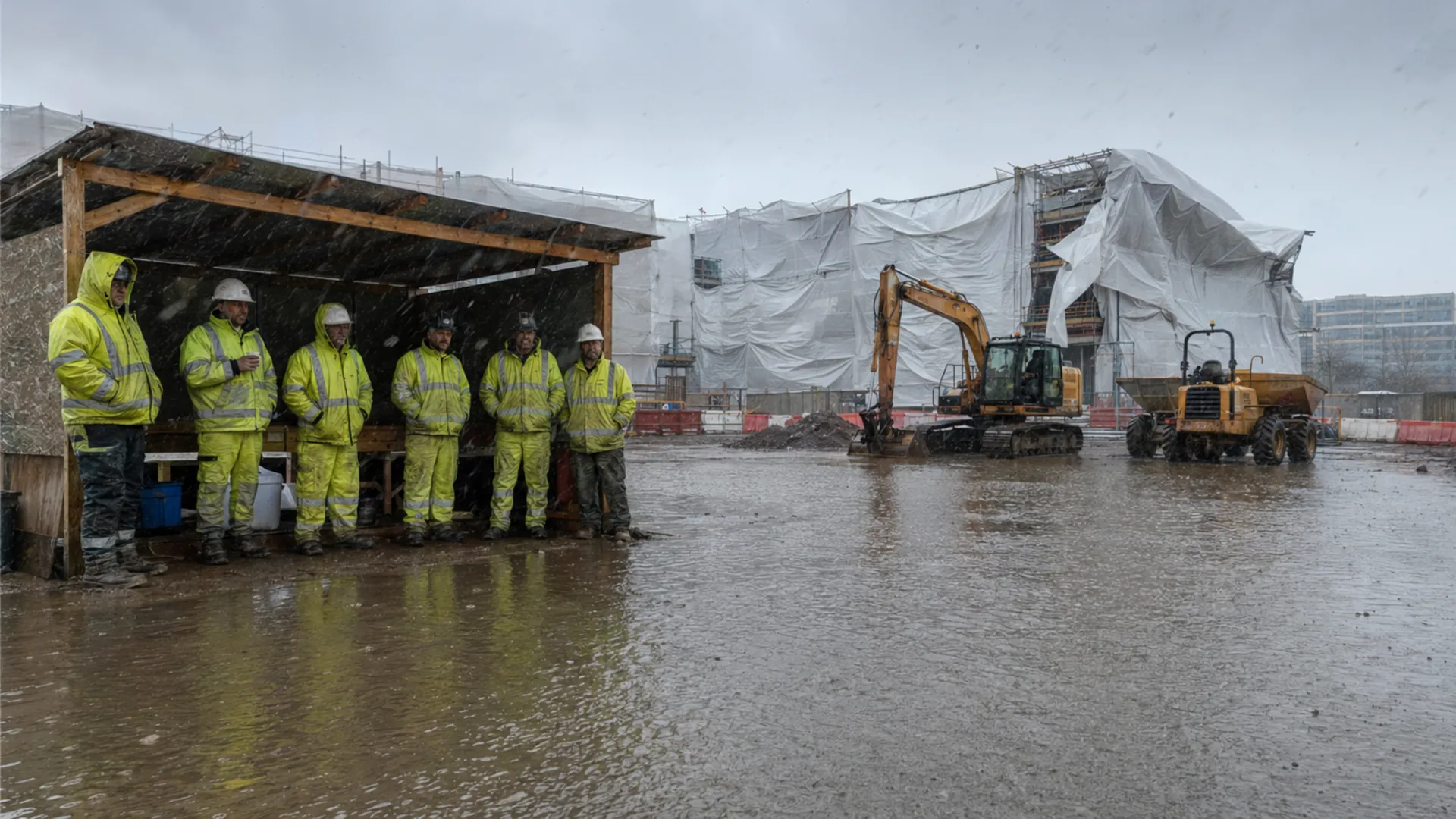
Weather records answer two different questions: whether the contractual measurement test is met, and what effect the weather had on the work. Keep those questions separate.
Apply the specified measurement test
Under standard NEC4 ECC clause 60.1(13), use the weather measurements specified in Contract Data, at the stated place and within a calendar month, with the required historical comparison. The test concerns a measurement shown by the weather data to occur on average less frequently than once in ten years. It is not a general rule that weather must fall below a threshold or that every unusually wet day qualifies.
Only the difference between the measured weather and the weather indicated by the contractual frequency test is taken into account in assessing the compensation event. For example, a difference in a specified count of qualifying days is not automatically the same number of days added to the Completion Date.
Record the effect on the works
Keep dates, locations, affected activities, resources, safety restrictions, progress and mitigation or redeployment. Show which work continued and which stopped. A weather measurement alone does not demonstrate the effect on Defined Cost or the programme.
Assessment must follow the applicable cost and time rules, including the dividing date and relevant Accepted Programme. Do not multiply every rain-affected shift by a daily rate and assume the result is recoverable.
Check the data source
An API or nearby station may provide useful context, but confirm that it supplies the location, units, measurement period and historical comparison required by the contract. Automated data is still open to questions about accuracy, completeness and relevance; it is not inherently indisputable.
Forecasts can help teams plan weather-sensitive work. They do not replace the contractual measurement used to establish an event.
Manage notices deliberately
Review completed calendar-month measurements promptly and record when the Contractor became aware of the qualifying event. Apply clause 61.3 and any relevant exception or amendment. Do not automatically start a separate eight-week clock on every wet day.
A diary entry or software alert is not itself a compensation-event notification. Use the required communication process and recipient. Early warning is also a distinct process.
A practical workflow
- Check the weather provisions and Contract Data at mobilisation.
- Record daily conditions and effects on the work.
- Obtain the specified calendar-month measurements and comparison data.
- Review whether the event test is met.
- Issue required notices and assess the relevant effects.
This approach makes the evidence reviewable without promising a particular recovery or an automatic programme extension.
Further reading
Check the contract form, edition, amendments, options, Contract Data and Scope used on your project.
Gather helps organise site records for review. Explore Gather’s site records.



.webp)