
Will
Hi and welcome back to a special episode of the Gather podcast. So special we've actually splashed out on a studio today.
My name is Will Doyle. I'm the founder and CEO of Gather, formerly Raildiary. In a past life, I was a chartered quantity surveyor building construction projects here in the UK and in Southeast Asia. One of my common challenges is around how we manage contracts. How do we deal with our supply chain and with our client as a contractor?
Today, I'm joined by two experts in this field, specifically in NEC contracts. First, we've got Nick Woodrow. Nick Woodrow is Operations Director at Gather, previously a civil engineer before. He worked at CEMAR together with our second guest, Ben Walker.
Ben Walker founded CEMAR, a contract management system you're probably all familiar with. Prior to that, Ben started working with the NEC in 2008 as a trainer, assessor and more recently, as a drafter.
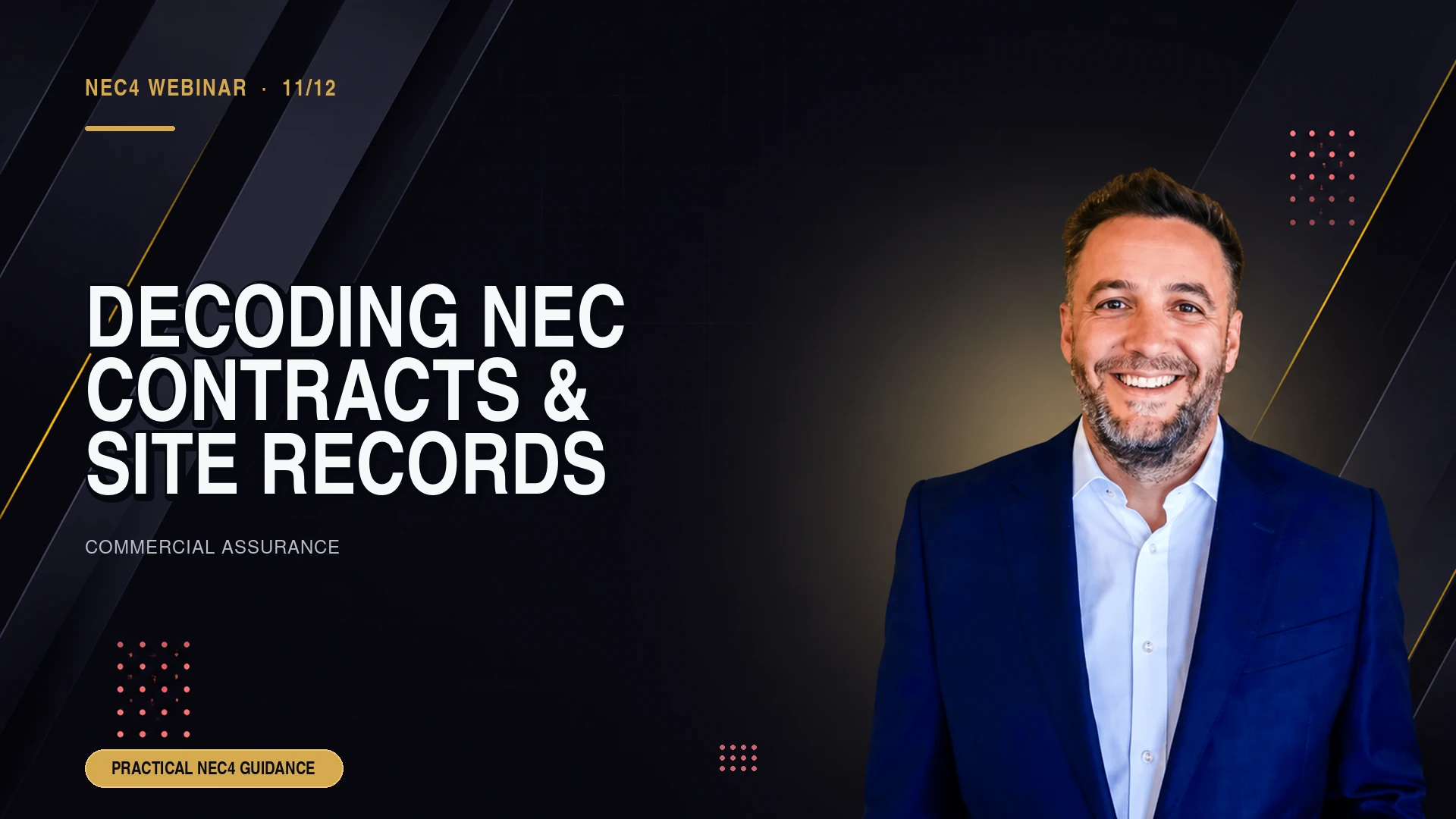
Today, I'm going to be talking through with Ben and Nick on how to best use site records to get the most out of your NEC contracts. I'd like you to introduce yourself and tell our audience about yourself and how you got into this role with NEC and with CEMAR. Thanks.
Ben
Great to be here. I started CEMAR from a real pain. I know you have first-hand experience of that. I've been site based for several years and really loved NEC. I've always thought it's a great contract. It's very focused in good project management practices.
Turns out that needs a lot of administration. So I found myself in a site hut Saturdays and Sundays doing admin. It didn't seem very satisfactory. So I thought there might be a better way of approaching it.
One example springs to mind is looking through the window of one of the site offices. I could see the note. I could see the clipboard hanging up with the next available early warning number on it. And even before we got into the meat and drink of managing a contract, just being able to number the next early warning was a nightmare because in the past you had to do it through email. So you'd have four or five people doing the same early warnings back and forth going, Have you used this number? Have you used that number?
And that always struck me. I thought, well, we've got to be able to do better than this. And that was really one of the triggers for looking into the kind of digital world and building CEMAR.
Will
Yeah. Brilliant. And for those that don't know, what does CEMAR stand for?
Ben
I don't think it stands for anything anymore. There's too many backronyms on it. Contract Event Management... I mean, people used to call it CEMAR. They used to call it all sorts. But I think originally from the kind of the founders of CEMAR, it was Contract Event Management and Reporting. That was the original.
Will
Excellent. Thanks.
Nick
So, Will, we should probably declare that we are both ex-CEMAR employees. And Ben was my boss for a few years. Yeah. Ben was one of my mentors and it was actually Ben who encouraged me to get training in NEC, which is why I'm at Gather now. Thanks, Ben. Appreciated.
Will
We should be paying Ben for all this.
Will
So, Ben, I'm going to kick off with a couple of broad questions, and I'll bring Nick in after that. We've got our audience watching. If you'd like to ask any questions of either Ben or Nick, you're very welcome to do so. Drop them in the chat and I'll bring them up on the screen.
So, Ben, what have been the challenges that you've seen around NEC contract management? What are the main challenges that you hear about?
Ben
I think some of the challenges are quite obvious. When I first started working with the NEC, the kinds of challenges you'd get were, how do I implement this in an organisation? How do I start using it? Some of those challenges haven't actually gone away, which is quite surprising, given the NEC has been around for 30 years.
But for the kind of main challenges... I suppose the first one, the main one is, a lot of people say it's admin-heavy, which I think is rubbish, frankly. But it is more admin than most people are used to if they've been on, let's say, an ICE contract or a JCT contract. The NEC asks you to do more administration.
But it's not difficult administration. It's more about having the discipline to do it regularly. And that's where a lot of people fall down, because they don't put the processes in place. They don't have the right tools, the right systems. And then it all kind of falls apart and becomes reactive rather than proactive.
The second challenge is around culture. So even if you've got the best systems in the world, if the culture of the organisation doesn't support collaborative working, doesn't support proactive management, then it doesn't matter what contract you're using, it's going to be a challenge.
And I think the third one, and this is probably the one that's most relevant to what Gather does, is around records. The NEC requires really good record keeping. And if you don't have good records, you can't administer the contract properly.
Will
You make a really, really good point. I see this day in, day out. The record piece is so important. The keeping of records is a day one item. When do you start keeping records? Day one. Because if you don't, when a compensation event comes along, you've got nothing to refer back to. And that's where a lot of contractors fall down.
Ben
Absolutely. And I think one of the things that people don't realise is that the NEC actually specifies what records you need to keep. If you look at clause 52, it talks about records. And there's a duty on both the contractor and the project manager to keep records. And the thing that catches a lot of people out is that the project manager has the right to instruct the contractor to keep records of anything they believe is going to be the subject of a compensation event. And if you don't keep those records, you're in a really difficult position.
Will
Absolutely. Nick, you've been in the field. You've been on the tools, so to speak. What's your experience of record keeping on NEC contracts?
Nick
I think Ben makes the point well. It's all about having the records in place. When I was on site, I used to make sure that my team were keeping daily records. And I mean proper records, not just a quick note on a piece of paper, but actual detailed records of what happened, who was there, what the weather was like, what plant was on site, what materials were delivered.
Because when you get to a compensation event, and it could be six months, twelve months down the line, you need to be able to go back and say, right, on this day, this is what happened. This is the impact it had. And if you don't have those records, you're relying on memory. And memory is notoriously unreliable.
I think the other thing that Ben touched on, which is really important, is the proactive nature of the NEC. The NEC wants you to deal with things as they arise. It doesn't want you to sit on things and then deal with them at the end of the project. It wants you to deal with compensation events as they happen. And to do that, you need good records.
Will
So, Nick, for our audience, could you explain what a site diary is? And how does it tie in to what you've been saying?
Nick
Yeah, of course. So a site diary, traditionally, is a daily record of what happened on site. And different organisations call it different things. Some call it a site diary, some call it a daily report, some call it a daily log. But essentially, it's the same thing. It's a record of what happened on that particular day.
And what you'd normally include in a site diary is things like the weather conditions, the number of people on site, what plant and equipment was on site, what work was carried out, any visitors to site, any health and safety incidents, any deliveries. And you might also include things like any instructions that were given, any problems that arose, any delays that occurred.
The important thing about a site diary is that it needs to be completed on the day. There's no point going back a week later and trying to remember what happened. It needs to be done on the day while it's fresh in your mind.
Will
Absolutely. And I think that's one of the challenges, isn't it? Getting people to actually do it on the day. Because people are busy, they've got other things to do, and filling in a site diary is often seen as a bit of a chore.
Nick
Yeah, absolutely. And I think that's where technology can really help. Because if you've got an app on your phone or your tablet, it's much easier to capture that information in real time rather than having to go back to the office at the end of the day and fill in a paper form or type it up on a computer.
Ben
And I think the key thing here is that the site diary is the foundation. It's the foundation of your record keeping. And if you get that right, everything else flows from it. Because your compensation events, your early warnings, your programmes, they all rely on having good underlying records. And the site diary is where it all starts.
Will
I couldn't agree more. And that's really the ethos of Gather, isn't it? We built Gather to make it as easy as possible to capture those records in real time on site. Because if you make it easy, people will do it. And if people do it, you've got the records you need to manage your contract properly.
So, Ben, let's talk about compensation events. Because I think that's where a lot of the value of good record keeping really comes through. Can you talk us through how compensation events work under the NEC and why records are so important?
Ben
Yeah, of course. So compensation events are the NEC's mechanism for dealing with change. And unlike some other contracts where you might have variations or claims, the NEC wraps everything up into compensation events. So whether it's a change to the works information, whether it's something that the project manager has done or not done, whether it's a physical condition, it's all dealt with through the compensation event process.
And the key thing about compensation events is that they're assessed based on the effect on the defined cost of the work that's been done and the work that's left to do, plus the fee. And to assess that properly, you need records. You need to know what actually happened. You need to know what resources were used. You need to know what the impact was on the programme.
And the really important point is that under clause 63.7, the project manager can assess a compensation event using their own assessment if the contractor hasn't submitted a quotation or if the quotation doesn't comply with the contract. And in that situation, the project manager's assessment is based on the project manager's own records and their own assessment of the impact. So if you haven't got good records as a contractor, you're at a massive disadvantage.
Will
That's a really, really important point. And I've seen that happen in practice. Where a contractor hasn't kept good records, the PM has assessed it, and the contractor has ended up getting significantly less than they should have because they couldn't demonstrate the actual impact.
Ben
And there's another angle to this as well, which is the time bar. Under NEC4, you've got to notify a compensation event within eight weeks. And if you don't, and the project manager hasn't notified it either, then you're time-barred. You lose it. And the way you spot a compensation event is by having good records. Because if you're keeping good daily records and you look back and you can see that something's changed or something's happened that wasn't expected, that's when you pick up the compensation event. If you're not keeping those records, you might not even realise that a compensation event has occurred until it's too late.
Nick
And I think that's a really important point. Because in my experience, a lot of compensation events are missed because people aren't keeping adequate records. They're not reviewing what's happening on site on a daily basis. And by the time they realise something's gone wrong or something's changed, the eight-week window has passed and they've lost the opportunity.
And it's not just about money. It's about time as well. Because compensation events also affect the programme. And if you don't notify a compensation event in time, you lose the entitlement to both the time and the money.
Will
So let me ask you both a question. In your experience, what percentage of compensation events do you think go unnotified? What percentage of potential compensation events are being missed?
Ben
That's a great question. I've seen various studies and various reports over the years. And the numbers vary. But I would say, conservatively, between 30 and 50 percent of compensation events are not being notified. And that's a huge amount of money and time that contractors are leaving on the table.
Nick
I'd agree with that. And I think it varies depending on the organisation and the project. But I've certainly seen projects where significant compensation events have been missed simply because the records weren't in place or the processes weren't in place to identify them.
Will
That's staggering. And that's really where I think AI can make a massive difference. Because one of the things that Gather does is we use AI to analyse site diary records to identify potential compensation events that might have been missed. So rather than relying on someone to manually review every single diary entry and cross-reference it with the contract and the programme, the AI can do that automatically. And that's a game-changer.
Ben
I think that's really exciting. And I think that's the direction the industry needs to go. Because the data is there. It's in the site diaries, it's in the records. But the challenge has always been extracting that information and making sense of it. And if AI can do that, then you're not leaving money on the table anymore. You're identifying compensation events as they arise, and you can deal with them properly.
Will
Absolutely. And I think there's a broader point here as well, which is about the quality of the records themselves. Because AI is only as good as the data you feed it. So if your site diaries are poor quality, if they're incomplete, if they're vague, then the AI is going to struggle. But if you've got good quality, detailed, consistent records, then the AI can do amazing things with them.
Nick
And I think that's where the app comes in as well. Because Gather is designed to prompt people to record the right information. So it's not just a blank page where you write whatever you want. It's structured. It prompts you to record the weather, the labour, the plant, the visitors, the work activities. And that structure means that the data is consistent and it's comprehensive. And that's what the AI needs to work properly.
Will
So let's talk about the future. Ben, where do you see things going with NEC contracts and technology?
Ben
I think we're at a really interesting point. I think the NEC has always been ahead of its time in terms of what it asks people to do. It was asking people to manage projects proactively long before anyone was talking about digital transformation. And I think the technology is now catching up with what the NEC has always wanted people to do.
So I think we'll see more and more use of AI and machine learning in contract management. I think we'll see more automation of the administrative processes. Things like notifying compensation events, producing quotations, updating programmes. A lot of that can be automated or at least assisted by technology.
And I think the other thing that's going to be really important is data analytics. Because if you've got all this data from your site diaries and your contract administration, you can start to analyse it across projects, across organisations. You can start to identify trends, identify risks, identify opportunities. And that's incredibly powerful.
Nick
I think Ben's spot on there. And I think the other thing that's going to change is the way that people interact with the contract itself. I think we'll see more natural language processing where you can ask a question about your contract and get an answer without having to be an NEC expert. And I think that's going to democratise contract management. Because at the moment, you need to be an expert to navigate the NEC properly. But if technology can help people understand what they need to do and when they need to do it, that's going to be a massive step forward.
Will
I love that vision. And I think that's exactly where Gather is heading. We want to make contract management accessible to everyone on the project, not just the QS or the project manager, but everyone. Because the better everyone understands the contract, the better the project outcomes.
So we've got a question from the audience. Let me read it out. "How important is it to have a dedicated NEC contract administrator on a project?"
Ben, what's your view?
Ben
I think it depends on the size and complexity of the project. On a large project, absolutely you need a dedicated person or even a team managing the contract administration. But on smaller projects, it might not be practical or cost-effective to have a dedicated person.
The key thing is that someone needs to be responsible for it. And they need to have the right tools, the right training, and the right support. And this is where technology can help, because it can take a lot of the heavy lifting out of the process. So even on a smaller project where you haven't got a dedicated contract administrator, if you've got a good system in place, the site team can manage a lot of the administration themselves.
Nick
I'd agree with that. And I think the other thing to say is that contract administration isn't just the QS's job. It's everyone's job. Because the site team are the ones who are recording what happens on site. The project manager is the one who's issuing instructions and receiving notifications. So everyone has a role to play. And the more you can involve the whole team in the process, the better the outcomes.
Will
Great points from both of you. We've got another question. "What's the most common mistake you see contractors make when managing NEC contracts?"
Ben
I think the most common mistake is not notifying compensation events in time. And that comes back to what we were saying earlier about records. If you're not keeping good records, you're not going to spot the compensation events. And if you don't spot them, you can't notify them. And if you don't notify them in time, you lose them.
The second most common mistake, I would say, is not submitting programmes. The programme is a really important tool under the NEC. It's not just a piece of paper that you produce at the start of the project and then forget about. It's a live document that needs to be updated regularly. And under the NEC, the contractor has an obligation to submit a revised programme at regular intervals. And if the contractor doesn't submit a programme, the project manager can withhold a quarter of the Price for Work Done to Date. That's a significant financial penalty.
Nick
And I'd add to that, not responding to communications in the time allowed. The NEC has really strict timescales for responding to things. And if you miss those timescales, there can be significant consequences. For example, if the project manager notifies a compensation event and the contractor doesn't respond with a quotation in the time allowed, the project manager can make their own assessment. And as Ben said earlier, that's usually not in the contractor's favour.
Will
All really good points. And I think the thread that runs through all of this is proactivity. The NEC rewards proactive management. If you're on top of your records, on top of your notifications, on top of your programme, you're going to get better outcomes. And if you're reactive, if you're playing catch-up, you're going to miss things and you're going to lose out.
So we're coming towards the end of our time today. I'd like to give you each a chance to sum up with one key takeaway for our audience. Ben, what's your one key takeaway?
Ben
I think my key takeaway would be: invest in your records. Whether that's through technology like Gather or through good processes and good training, make sure that you're keeping detailed, contemporaneous records from day one. Because those records are the foundation of everything else. They're the foundation of your compensation events, your programme, your cash flow. Everything flows from your records.
Nick
And my takeaway would be: make it easy. Make it as easy as possible for your team to capture the information they need to capture. Because if it's easy, they'll do it. And if they do it, you'll have the records you need. And the best way to make it easy is to use the right technology. Use an app that prompts them, that guides them, that makes it a part of their daily routine rather than an extra burden.
Will
Brilliant. Thank you both. I think those are fantastic takeaways. Just to summarise what we've talked about today. Good records are the foundation of good NEC contract management. Site diaries are the starting point for those records. Technology and AI can help you capture better records and extract more value from them. And the NEC rewards proactive management.
Thank you, Ben, for joining us today. It's been fantastic to have your expertise and your insights. And thank you, Nick, for sharing your practical experience from the field. And thank you to our audience for watching and for your excellent questions.
If you'd like to find out more about Gather and how we can help you manage your NEC contracts more effectively, head over to gatherinsights.com. And if you'd like to get in touch with Ben, I'm sure he'd be happy to hear from you.
Thanks everyone. See you next time.
Ben
Thanks, everyone. Great to be here.
Nick
Thanks, all. Bye.
This podcast highlighted how important shift records and site records are for NEC projects.


.webp)